
The immediate answer
To improve a school carline, first separate pedestrian and vehicle movements, create one unambiguous circulation path, stage students away from traffic, use several controlled curb-side loading positions, and move exceptions out of the active lane. Then measure queue reach, clearance time, student readiness and unsafe movements for at least a full school week before changing the design again.
Do not optimize solely for vehicle throughput. A line can move faster by creating unsafe pressure, hiding unresolved students or shifting congestion onto a public road. Physical changes should be reviewed with district facilities, transportation staff, accessibility specialists and relevant local traffic or emergency authorities.
Map the real dismissal system
Stand at the campus edge and record where each movement begins, crosses and ends: family vehicles, buses, walkers, cyclists, staff vehicles, accessible loading, aftercare transfer and emergency access. Repeat the observation in rain, on an early-release day and when a bus is late. Mark every location where a child and a moving vehicle can occupy the same space.
The National Center for Safe Routes to School guide recommends clearly delineated queues, keeping queues out of student crosswalks, and using visible curb-side assistants to direct students between vehicles and pedestrian areas. Temporary use of school grounds may help constrained campuses, but use of fire lanes or public rights-of-way requires appropriate approval.
A six-phase operating plan
Before vehicles arrive
Confirm the day’s pickup plans and changes, assign staff positions and backups, inspect cones and signs, clear pedestrian crossings, prepare the supervised student staging area, and brief staff on weather or transportation exceptions.
Queue entry
Give drivers one obvious entry and prevent merging decisions near children. Keep the queue from blocking intersections, crosswalks, bus movements, emergency access and neighboring driveways. Coordinate changes involving public roads with the appropriate local authorities.
Student staging
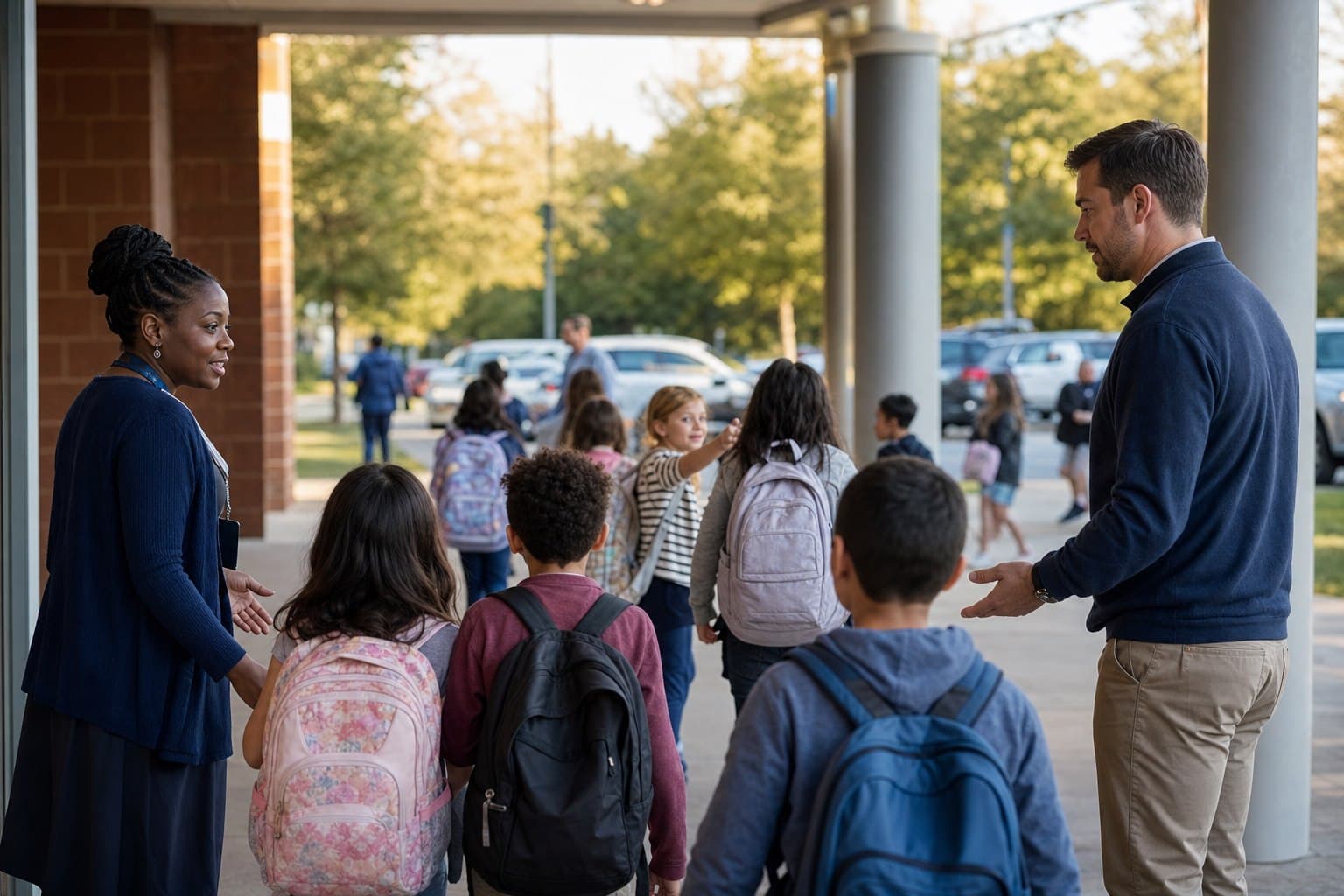
Organize students so staff can prepare the right child without sending children into moving traffic. Separate walkers, buses, aftercare and car pickup, and define a supervised place for unresolved plans.
Loading zone
Use a clearly marked curb-side zone, stop vehicles fully, load only in designated positions, and release vehicles in a controlled wave. Adults assisting vehicles should be visible and trained; children should not weave between cars.
Exception lane
Move identification questions, unexpected collectors, missing students and plan conflicts out of the active loading sequence. Keep the child supervised while the dismissal lead resolves the issue.
Close and reconcile
Confirm every staged student reached a resolved destination, record material exceptions, remove temporary traffic controls, and capture one or two observations while the operation is still fresh.
Fix the common bottlenecks at their source
- Drivers form multiple queues: simplify entry, reinforce one circulation path and place staff before the split occurs.
- Children are not ready: improve the connection between the arriving vehicle and supervised staging rather than calling names farther into traffic.
- Parents leave vehicles: clarify the curb-side loading procedure and create a separate location for matters requiring conversation.
- Cars pass the line: remove ambiguity about through movement and engage local traffic professionals where public streets are involved.
- Walkers cross the queue: relocate or actively control the crossing; do not ask young children to negotiate moving gaps.
- Late changes reach the curb: resolve them through the school’s same-day pickup change workflow, not through messages between vehicles.
Measure what staff can improve
| Measure | How to use it |
|---|---|
| Queue clearance time | Minutes from the first active pickup wave until the final routine vehicle leaves. |
| Longest observed queue | Where the queue ends at peak—not where staff hope it ends. Note blocked crossings or access points. |
| Vehicles loaded per wave | How many designated loading positions are actually used safely and consistently. |
| Exception count | Plans, collectors or students removed from the active line for resolution, grouped by cause. |
| Student search events | How often a vehicle reaches loading before the correct student is ready. |
| Near misses and unsafe movements | Pedestrian conflicts, passing, reversing, wrong-side loading or children entering the vehicle zone early. |
Record context with the numbers: weather, staffing, special events, late buses and unusual enrollment patterns. Use medians and ranges rather than celebrating one unusually fast day. Any near miss deserves review even when overall time improves.
Run a five-day improvement cycle
- Day 1—observe: change nothing; map queues, crossings, waits and exceptions.
- Day 2—stabilize roles: assign fixed positions, backups and a dismissal lead.
- Day 3—remove one conflict: adjust the highest-risk crossing or confusing merge with approved controls.
- Day 4—improve readiness: tighten the link between current pickup plans, vehicle arrival and student staging.
- Day 5—rehearse disruption: test an unexpected collector, absent staff member, late bus and connectivity failure.
Debrief with classroom staff, office staff, transportation, families and accessibility stakeholders. Keep what measurably improves safety and predictability; reverse changes that simply move the problem elsewhere.
Family instructions should fit on one screen
Enter at [location] and follow the single marked queue. Display the school’s approved pickup identifier if required. Remain in the vehicle, follow staff direction, load only in the designated zone, and do not pass other vehicles. Submit dismissal changes through [channel] before [time]. If the student is not ready or the plan needs review, staff will direct you to the exception location.
Translate the instructions, include a simple campus map, explain accessible alternatives, and repeat them before the first day and after any traffic-flow change.